

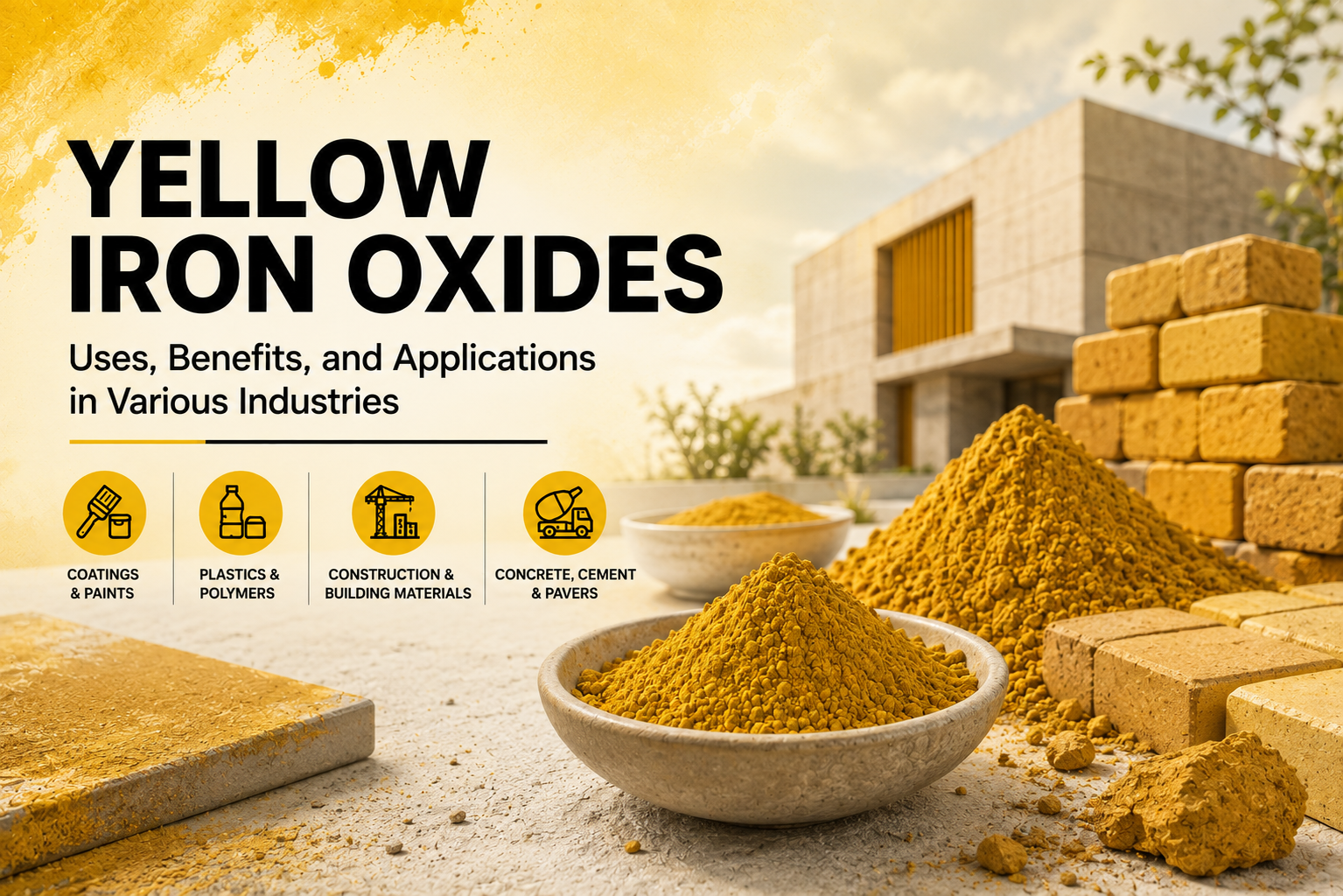
Yellow Iron Oxide is an inorganic pigment with a yellow color, tinting strength, opacity and stability. It is used to impart a uniform colour to products like paints, coatings, construction materials, plastics, rubber, ceramics, and other formulations. The required shade, the characteristics of the particles, the dispersion and the application conditions determine the required grade.
Yellow Iron Oxide is an inorganic colour pigment which is used to create yellow and earthly colour in industrial and commercial products. It comes in natural and synthetic variety, and synthetic grades are more likely to provide a greater amount of control of colour consistency and particle characteristics. It is traditionally believed to be hydrated iron oxide; sometimes it is represented as FeO(OH)·nH₂O, depending on the composition and water content of the pigment. Yellow iron oxide pigment is also known as Ferric Oxide Yellow.
The material is not only appreciated for its colour but also for its stability and compatibility with most of the binders and base materials.
| Property | Description |
|---|---|
| Colour | Yellow to yellow-brown shades |
| Pigment type | Inorganic pigment |
| Chemical basis | Hydrated iron oxide |
| Forms | Natural and synthetic |
| Tinting strength | Suitable for colour formulation |
| Opacity | Useful for producing solid shades |
| Light stability | Suitable for many outdoor applications |
| Heat stability | Suitable for selected industrial processes |
| Dispersion | Depends on grade and formulation |
| Compatibility | Used with various binders and matrices |
The exact performance of a pigment depends on its grade, particle size, purity, concentration, and formulation conditions.
Yellow Iron Oxide offers several characteristics that make it useful across different formulations.
1. Consistent Colour
If a suitable grade is chosen, a consistent and predictable yellow color can be achieved. This is crucial for manufacturers who create lots with the same visual characteristics.
2. Good Tinting Strength
Yellow iron oxide can be used as an effective colour development even with the use of other pigments. It is useful for tinting to all shades of yellow, beige, tan and earth tone.
3. Light Stability
The pigment is particularly suitable for use in certain exterior coatings and construction products due to its resistance to colour change when exposed to light.
4. Thermal Stability
Depending on the grade and processing temperature, yellow iron oxide can be incorporated into applications where moderate heat resistance is required. Processing conditions should always be checked against the pigment's technical specifications.
5. Versatile Application
Being compatible with various formulation systems, yellow iron oxide can be applied to paints and coatings, concrete products, plastics and rubber, ceramics, and others.
6. Natural Earth-Tone Shades
When paired with appropriate pigments, the pigment can add warm yellow, ochre, beige, brownish-yellow and other earth tones.
The broad application range of yellow iron oxide comes from its combination of colour performance, stability, and compatibility.
Paints and Coatings
Yellow iron oxide is one of the most popular oxides used in decorative and industrial coatings to produce the yellow, cream, beige, ochre and earth tone colours.
It can be incorporated into:
Architectural paints
Industrial coatings
Protective coatings
Exterior coatings
Decorative finishes
Primer and coloured coating systems
The appropriate grade should be selected according to the binder system, required shade, dispersion requirements, and exposure conditions.
Construction Materials
One of the important applications of Iron Oxide Yellow is the colouring of cement-based products.
It can be used in:
Coloured concrete
Paving blocks
Concrete tiles
Interlocking pavers
Precast products
Cement flooring
Decorative concrete
Because the pigment becomes part of the cementitious matrix, manufacturers can develop consistent colours for architectural and landscaping products.
Plastics
Yellow iron oxide can be incorporated into selected plastic formulations to provide yellow and earth-tone shades.
Applications may include:
Plastic components
Construction plastics
Consumer products
Moulded articles
Plastic profiles
Pigment selection should consider the processing temperature and polymer type to ensure that the colour remains suitable during manufacturing.
Rubber Products
In rubber formulations, yellow iron oxide can be used where a stable inorganic colourant is required.
It may be incorporated into selected:
Rubber sheets
Rubber components
Industrial rubber products
Moulded rubber articles
The pigment's compatibility with the rubber formulation and processing conditions should be evaluated before large-scale production.
Ceramics
Yellow iron oxide is also employed in ceramics to give yellow and earth tones. The final colour may be very dependent on firing conditions, atmosphere, glaze formulation and loading level of the pigment. So, ceramic manufacturers usually do tests before formulating a production product.
Yellow iron oxide can be sourced from natural deposits or manufactured synthetically.
| Feature | Natural Yellow Iron Oxide | Synthetic Yellow Iron Oxide |
|---|---|---|
| Source | Naturally occurring mineral material | Controlled manufacturing process |
| Colour consistency | Can vary by source | Generally more controllable |
| Composition | Depends on mineral deposit | Can be controlled during production |
| Particle characteristics | Depends on processing | More controlled |
| Application | Suitable for selected general applications | Suitable where consistent specifications are important |
The choice between natural and synthetic material depends on the required colour, consistency, purity, performance, and application.
For commercial procurement, buyers should request technical information rather than comparing suppliers only by price.
Important points include:
Pigment shade
Chemical composition
Tinting strength
Particle size
Moisture content
Purity
Packaging
Batch consistency
Certificate of Analysis (COA)
Recommended application
Storage requirements
Available order quantities
A clear technical specification helps manufacturers compare grades and reduce colour variation between production batches.
In those products where colour or product specification are important, Selective Minerals and Color Industries Pvt. Ltd. is a major supplier of iron oxide pigments for applications where colour performance, consistency and suitability are important. The consumer can evaluate the pigment used in terms of required shade, method of application and formulation, and in terms of required characteristics of the pigment, and select a pigment according to its manufacturing process instead of the name of the color.
1. What is Yellow Iron Oxide used for?
Yellow Iron Oxide is used as an inorganic pigment in paints, coatings, construction materials, plastics, rubber, ceramics, and other products requiring yellow or earth-tone colours.
2. What is the difference between yellow iron oxide and yellow dye?
Yellow Iron Oxide is an insoluble inorganic pigment that provides durable colour.
A yellow dye is a soluble colourant mainly used when brighter or more transparent colour is required.
3. Is Yellow Iron Oxide suitable for concrete?
Yes. Yellow iron oxide can be used to colour concrete products such as paving blocks, tiles, precast products, and decorative concrete. Final colour depends on pigment dosage and the other raw materials used.
4. What is the difference between natural and synthetic Yellow Iron Oxide?
Natural material comes from mineral sources, while synthetic pigment is produced under controlled manufacturing conditions. Synthetic grades generally offer greater control over colour and particle characteristics.
5. How do I choose the right Yellow Iron Oxide?
Consider the required shade, tinting strength, particle characteristics, purity, heat exposure, light exposure, dispersion, and compatibility with the final product formulation.
Yellow Iron Oxide is a versatile inorganic pigment that is used in wide range of manufacturing applications requiring durable yellow and earth tone colors․ These include paints and coatings‚ construction products‚ plastics & rubber‚ and ceramics․ The appropriate pigment is selected based on the desired color and end-use requirements․ For optimal results‚ manufacturers should identify Ferric Oxide Yellow grades based on their technical specifications‚ color characteristics‚ grade particle characteristics‚ and suitability for application․ Choosing the correct grade and controlling dispersion and formulation can provide the expected performance properties for applications․