

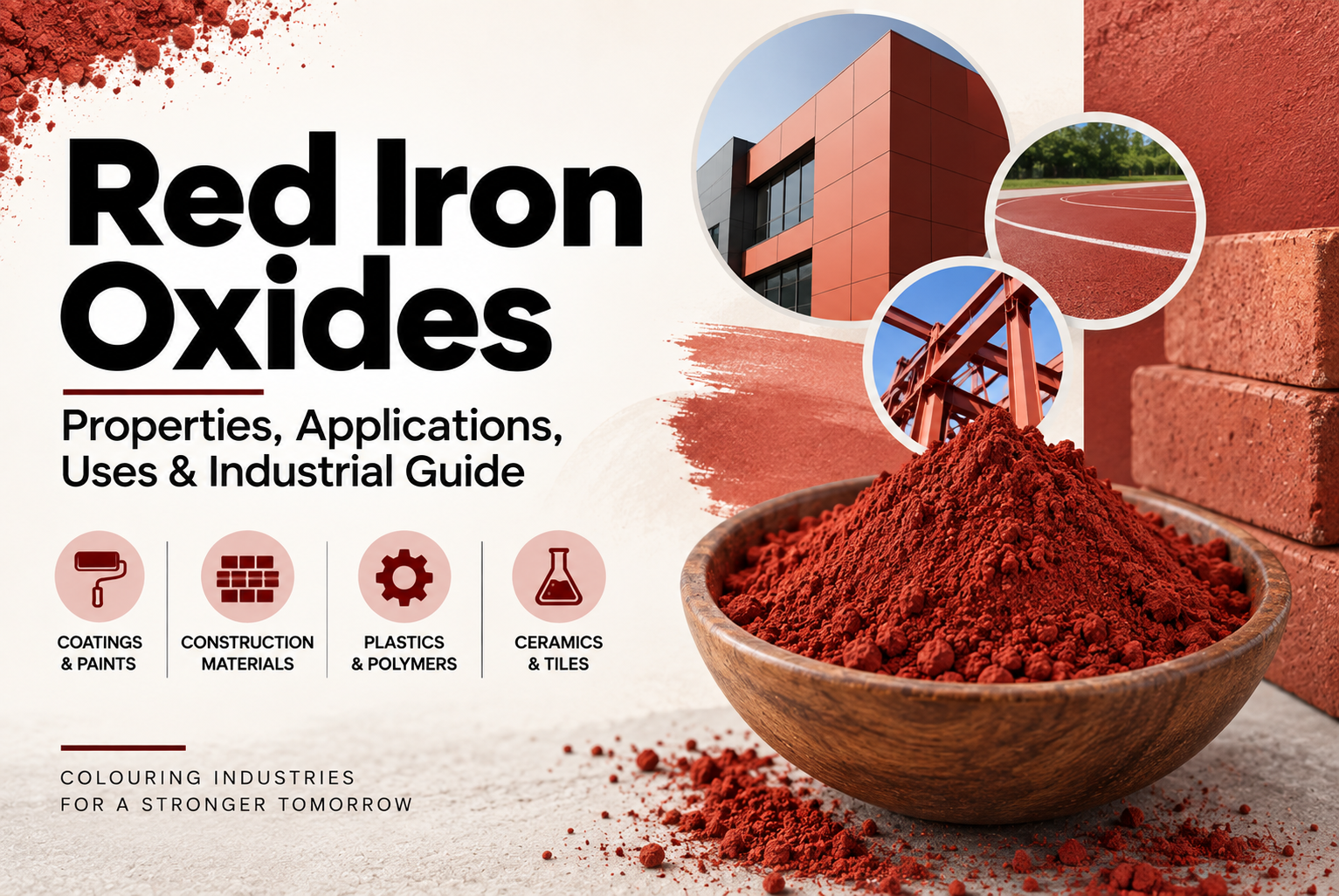
Choosing a good pigment is crucial if the product must be a uniform colour and have uniform performance. Red Iron Oxides are employed in building materials, paints and coatings, plastics, ceramics, rubber and other industrial applications to produce red, earth tone colors. But matching colour is not the only reason for selecting a grade. These can be affected by tinting strength, particle characteristics, processing conditions, chemical compatibility and batch consistency. These factors can be used to help choose an appropriate grade for different production needs, by manufacturers and industrial buyers.
Red Iron Oxides are inorganic pigments which are used in providing red, reddish brown, terracotta and related shades in various industrial materials. They are mostly used in connection with iron(III) oxide-based pigments and come in various grades suitable for various processing and application needs. The quality of the pigment may be affected by the way it was made and its physical properties. The different properties of a pigment such as colour strength, particle size, dispersion behaviour, heat stability and application compatibility may all affect the performance of the pigment in a pigment formulation. Red Iron Oxide is not a soluble dye, but rather an insoluble pigment in the application medium. This property is helpful in products where the colour must be retained in the finished product.
Industrial pigment selection affects both the appearance and performance of the finished product. A pigment that provides the required colour but does not disperse properly or withstand the processing environment may create inconsistent results.
Important performance considerations include:
Colour consistency: Helps maintain a uniform appearance across production batches.
Tinting strength: Influences the amount of pigment required to achieve the desired shade.
Light stability: Helps the colour remain consistent during exposure to light.
Weather resistance: Important for products intended for outdoor applications.
Chemical stability: Supports use in different industrial formulations.
Heat stability: Relevant to manufacturing processes involving elevated temperatures.
Alkaline stability: Particularly important for cement and concrete applications.
Dispersion: Helps distribute pigment evenly throughout the finished product.
The importance of each property depends on the end use. For example, a pigment intended for concrete may require different characteristics from one used in plastics or industrial coatings.
Different applications require different pigment characteristics. Buyers should review the technical properties that directly affect their manufacturing process.
| Property | Why It Matters |
|---|---|
| Colour consistency | Helps maintain the required shade between batches |
| Tinting strength | Influences colour intensity and pigment dosage |
| Particle characteristics | Affect dispersion and finished appearance |
| Lightfastness | Supports colour retention during light exposure |
| Weather resistance | Useful for exterior applications |
| Heat stability | Important for high-temperature processing |
| Alkaline stability | Relevant to cement-based products |
| Opacity | Helps provide effective colour coverage |
| Dispersion | Supports uniform pigment distribution |
| Chemical stability | Helps maintain performance in suitable formulations |
These properties should be considered together when evaluating a grade.
Red Iron Oxides have applications across several manufacturing industries. The grade and dosage can vary according to the material into which the pigment is incorporated.
Construction is an important application area for red iron oxide pigments. They can be used to add red, brick, terracotta, and other earth-tone colours to cement-based and concrete products.
Common applications include:
Paving blocks
Interlocking pavers
Precast concrete
Roof tiles
Mortar
Construction blocks
Decorative concrete
Cement-based products
Landscaping products
For these applications, pigment compatibility with the alkaline environment is an important consideration. Proper mixing and dosage are also necessary to achieve uniform colour.
Red iron oxide pigments are used in selected architectural, industrial, protective, and other coating formulations.
Coating manufacturers may evaluate:
Colour consistency
Opacity
Tinting strength
Dispersion
Weather resistance
Compatibility with the coating system
Processing requirements
For exterior coatings, resistance to sunlight and environmental exposure can be particularly important.
Red iron oxide can be incorporated into selected plastic and rubber formulations where an inorganic red colourant is required. In these applications, manufacturers need to consider processing temperature, pigment dispersion, colour strength, and compatibility with the polymer system. The pigment grade should be selected according to the processing conditions rather than simply choosing the strongest colour available.
Red iron oxide pigments can contribute red and earth-tone shades to ceramic products and selected glass applications. Ceramic manufacturers should consider the firing conditions and the interaction between the pigment and the ceramic formulation. Testing the selected grade under actual production conditions can help determine whether it provides the desired colour and performance.
Red Cement Powder is commonly associated with cement-based material containing a red colouring pigment. Red Iron Oxide can be incorporated into cementitious formulations to create decorative red, brick, terracotta, and related shades.
These coloured materials can be used in:
Decorative flooring
Paving products
Walkways
Architectural concrete
Landscaping products
Exterior surfaces
Decorative cement applications
The final colour is influenced by more than the pigment itself. Cement colour, aggregate, pigment dosage, mixing conditions, moisture, curing, and the overall formulation can all affect the finished appearance.
Key Fact: Consistent pigment dosage and proper mixing are important for achieving a uniform colour across coloured cement and concrete products.
For regular industrial procurement, buyers should evaluate technical and commercial factors together.
A practical checklist includes:
Price is an important commercial factor, but it should be considered alongside product consistency and application performance. A lower-cost pigment may not provide the same results if a higher dosage or additional formulation adjustment is required.
The benefits depend on the selected grade and application, but red iron oxide pigments are commonly considered for applications requiring:
Durable inorganic colour
Consistent red and earth-tone shades
Good tinting strength
Suitable light stability
Weather-resistant colour performance
Compatibility with selected construction materials
Use across multiple industrial formulations
Different grade and application options
The actual performance should always be evaluated against the requirements of the finished product.
At Selective Minerals Pvt. Ltd., we understand that industrial buyers and manufacturers require consistent raw material quality and dependable supply for regular production. As Red Iron Oxides manufacturers in India, we focus on maintaining consistent colour, tinting strength, particle characteristics, and product quality according to application requirements. Our approach is focused on supporting buyers with suitable grades for different industrial applications.
1. What are Red Iron Oxides mainly used for?
Red Iron Oxides are mainly used as inorganic pigments in construction materials, paints and coatings, plastics, ceramics, rubber, and other industrial products.
2. Is Ferric Oxide Red the same as Red Iron Oxide?
Ferric Oxide Red is a commonly used term for red iron oxide pigment associated with iron(III) oxide-based pigments.
3. Why is Red Iron Oxide used in concrete?
It is used to add red, brick, terracotta, and other earth-tone colours to concrete and cement-based products.
4. How do I select the right Red Iron Oxide grade?
Consider the required shade, tinting strength, particle characteristics, processing temperature, chemical environment, dispersion, and final-product requirements.
5. Can Red Iron Oxides be used for international industrial orders?
Yes. Buyers can source red iron oxide for international applications, but specifications, packaging, documentation, quantities, and shipment requirements should be confirmed before ordering.
Red Iron Oxides are versatile inorganic pigments that are employed in construction, coatings, plastics, ceramics, rubber and other manufacturing industries. Further to the required colour, grade, tinting strength, particle characteristics, processing conditions, chemical compatibility and batch consistency can all affect their suitability. These parameters can be reviewed prior to procurement and application trials can be performed when needed to choose a grade to best suit production requirements for the manufacturer and/or industrial buyer. For bulk and regular application, buyers may discuss their application, technical requirements, packaging, and supply requirements with Selective Minerals Pvt. Ltd. to find a suitable solution of red iron oxide.